Showing posts with label Fertility. Show all posts

Tuesday, 7 July 2015

Caffeine Could Seriously Harm Men's Fertility: Should We All Just Quit?

Caffeine has hit the headlines again as it's been found to seriously affect men's fertility. New research has found that drinking just two strong cups of Joe a day could halve their chances of conceiving a child.
We know that too much caffeine isn't super duper healthy for us, but can our beloved coffee and tea really be that harmful to our health? And are we unwittingly drinking far more than is healthy without even realising?Coffee - should we give up our caffeine fix?Coffee - should we give up our caffeine fix?

In the past women have been warned not to overdo caffeine in pregnancy and there are studies suggesting it can raise the risk of miscarriage - so most women trying to conceive cut down anyway.
But this seems to be the first time men have been warned that their caffeine consumption could affect parenthood.
The research at Massachusetts General Hospital in Boston showed that men who drank 265gm of caffeine a day had the least chance of becoming fathers. Experts suggest this could be because caffeine may harm sperm at a molecular level.
And though men who aren't trying to conceive might not think that they have anything to worry about, it definitely raises questions about what else caffeine might be doing to our health that we have no idea about.
Last year the editor in chief of the Journal of Caffeine Research Dr Jack James suggested caffeine-containing products need health warnings similar to those found on cigarette packets.
Dr James, who is head of the department of psychology at Reykjavik University, Iceland, has claimed that we're all consuming way more caffeine than we think we are.


According to him, manufacturers include it in all kinds of products you wouldn't expect from chewing gum to painkillers.
But it's confusing because research and recommendations about caffeine seem very conflicted and ever changing. While some experts suggest we eschew is stuff is entirely, other studies have found that in small amounts, say two cups of coffee a day, it can be beneficial.

Some countries in Europe and Scandinavia are already taking action to regulate how much caffeine is used and in what products, but in the UK we still presume it to be more or less harmless.Coffee - Is it even worst for us than we thought? (REX)Coffee - Is it even worst for us than we thought? (REX)

Should we give up caffeine altogether?

Should we be ditching our coffee habits ASAP and do we need to be checking all the foods, drinks, medicines and even cosmetics we use to make sure we're not over-doing it?

It's suggested adults only consume 400mg of caffeine a day (two cups of instant coffee or four of tea). To put this into perspective, one large Starbucks coffee contains 360mg. So savour your morning cup as you shouldn't be drinking any more that day.
Though some studies have linked moderate caffeine consumption to better kidney function and a reduction in gallstones, and even heart benefits, experts remain cautious.

Migraine expert Dr Nicholas Silver, consultant neurologist at The Walton Centre for Neurology and Neurosurgery, told Yahoo! Lifestyle that he believed we could get rid of 80 per cent of chronic illnesses, sleep problems, migraines and headaches if we simply stopped consuming caffeine.If you suffer from headaches or migraines, try cutting out caffeine ©RexIf you suffer from headaches or migraines, try cutting out caffeine ©Rex
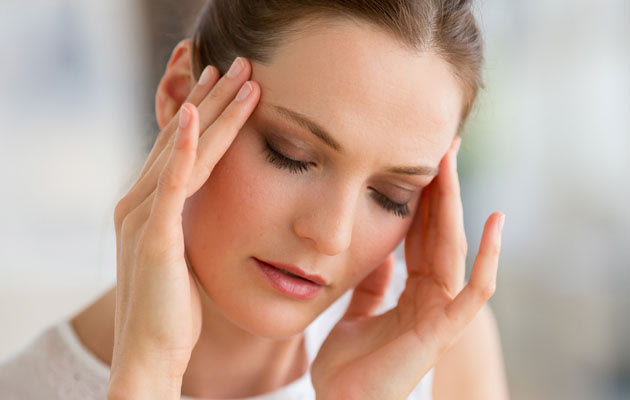
Women should also bear in mind that caffeine stops your body being able to absorb iron, which could end up leaving you deficient (anaemic) and making you feel more tired - and reaching for another cuppa.

But ultimately there is no right or wrong answer. Individuals respond differently to all drugs and caffeine is no differently. Signs of overdoing it include a racing heartbeat and palpitations, anxiety, an upset stomach, dizziness and insomnia.
If you are suffering from these, are feeling antsy, having troubles sleeping or regularly get headaches or migraines, you may want to try giving up caffeine to see if it helps.
However if you're a moderate coffee drinker and see no ill effects, there's no need to immediately ditch your favourite beverage - unless of course, you're a man having trouble conceiving, in which case get on the decaff stat.
Try swapping one of your daily coffees for a green or other herbal tea and see if you feel better for it. It still contains caffeine but at lower levels and with the added boost of healthy antioxidants.


Friday, 24 April 2015

10 surprising things that improve your sex life

Crazy things that make sex better

Lots of things can improve your sex life, but some of them can be strange, scary and very surprising. Here are 10 shocking things that can make your sex life fantastic:
10 surprising things that improve your sex life

Embracing your booty

You may hate your big behind, but the chances are he secretly loves it. Although a lot of women want smaller butts, research has found that men are attracted to bigger rears because they signal a woman’s fertility.

The Swiss-ball

It turns out that the most fun piece of gym equipment around can also improve your sex life. Guys, you should do Swiss-ball press-ups, whilst girls you should use the Swiss ball to do kegels and ball squeezes. This will strengthen your pelvic floor muscles.

Celery

The time when a salad was a food for girls is gone fellers, and if you want to improve your sex life you better start chomping on the green stuff. Celery releases pheromones when you eat it that turn you on, and in turn makes you more attractive to women.

Sex bans

Denying yourself for short periods will give you a great build up and when you do finally indulge, the sex will be amazing. If you can’t manage a sex ban, instead use the no-touch rule, where you can’t touch your bed buddy, unless you use a “tool”, like a scarf or a feather. 

Hugging

Research suggests that the closer a couple feels to each other the more sex they have. Hugging increases your oxytocin levels – the hormone that makes us feel intimate with the person we’re hugging. So if you want more loving, get cuddling.

Scars

Although scars may make you think of pirates, apparently women love them. Men with mild facial scars were ranked as more attractive. For those guys who want a long-term girl though, scars are not the thing to go for. Women said men with scars were not marriage material.

Having another birthday

If you want better sex then it’s time to have another birthday as researchers have found that older people have better sex. They cite better body image, more confidence and a stronger relationship as being the key reasons older people have better sex.

Sucking toes

For many the thought of someone else’s feet makes them queasy, but to a lot of people feet are a big, big turn on. In fact, feet are the most popular fetish, so even if you don’t think you like your partner’s toes maybe it’s time you give them a little attention – you may be surprised. 

Chocolate

Not many people need an excuse to tuck into some chocolate, but if you are one of those people then remember that a few squares of dark chocolate can boost both your energy levels and your mood; in turn this will improve your sex life.

Long legs

We all know that men love long legs, but it seems women like their guys to have a giraffe-like pair of pins too. People whose legs are 5% longer than average are considered more attractive. So if you want more sex invest in some high heeled shoes.

Friday, 6 March 2015

Fertility tests

Fertility tests

If you've tried unsuccessfully to get pregnant for a year or more through regular unprotected sex, it’s time to see your GP. If you're a woman over 35, or if you think that either partner may have a fertility problem, see your GP after six months of trying. A fertility problem could be because you've had surgery that may have affected your reproductive organs, or because you've had a sexually transmitted infection (STI), such as chlamydia, that may have damaged your fertility.
Many couples with fertility problems go on to conceive, with or without fertility treatment.

What to expect

If you make an appointment to see your GP because you're having trouble becoming pregnant, they will ask how long you’ve been trying. If it's been less than a year or you haven’t been having unprotected sex regularly, and there is no reason to suspect you may have a fertility problem, your GP may recommend you keep trying for a while to see if you conceive naturally. Having regular sex means having sex every two or three days throughout the month. You can find out more about maximising your chances of getting pregnant.
If you've been having regular unprotected sex for more than a year, your GP may recommend a range of tests to determine what's stopping you from conceiving.

Fertility tests

This page lists some of the most common initial fertility tests. Your GP can refer you for these tests, which will usually happen in hospital or at a fertility clinic.

Sperm test

In about one-third of cases, fertility problems are due to the male partner. Sometimes, a lack of sperm or sperm that are not moving properly can cause a failure to conceive. Your GP can arrange a sperm test. The male partner will be asked to produce a sperm sample and take it for analysis, probably at your local hospital.

Blood tests to check ovulation

Levels of hormones in a woman's blood are closely linked to ovulation, when the ovaries release an egg into the fallopian tubes. Hormone imbalances can cause ovulation problems, and a blood test can help determine whether this is happening. Going through a phase of not having periods, or having irregular periods, are also signs of ovulation problems. The most common cause of ovulation problems is polycystic ovary syndrome.

Test for chlamydia

Chlamydia is the most common STI in the UK. It can cause pelvic inflammatory disease and fertility problems. Your GP can refer you for a test for chlamydia. This can be a urine test or a swab from the urethra (the tube from which urine passes) or the neck of the cervix.

Ultrasound scan

An ultrasound scan can be carried out to check the woman's ovaries, womb and fallopian tubes. In a transvaginal ultrasound scan, which takes place in hospital, a small ultrasound probe is placed in the vagina. This scan can help doctors check the health of your ovaries and womb. Certain conditions that can affect the womb, such as endometriosis and fibroids, can prevent pregnancy from occurring. The scan can also check for blockages in your fallopian tubes (the tubes that connect the ovaries and the womb), which may be stopping eggs from travelling along the tubes and into the womb. The Human Fertilisation & Embryology Authority (HFEA) estimates that around one-third of women with fertility problems have blocked or damaged fallopian tubes.

X-ray of fallopian tubes

This is called a hysterosalpingogram (HSG). Opaque dye is injected through the cervix while you have an X-ray. The dye will help your doctors to see if there are any blockages in your fallopian tubes. Blockages can prevent eggs passing down the tubes to the womb, and so stop pregnancy occurring. Find out more about testing for and diagnosing infertility problems.

What's next?

In around 80% of cases of persistent failure to become pregnant, these tests will uncover a cause. In the remaining 20% of cases, no clear cause can be found.

Saturday, 31 January 2015

Top 10 fashion health hazards

10 shocking ways fashion affects your health

From skyscraper heels to skin tight jeans, many of us repeatedly choose style over comfort. However, this could be bad news for your health. Here are the top 10 items of clothing which can put your health at risk.

Fashion health hazard 1: Skinny jeans

Skinny jeans may be fashionable, but wearing skin-tight denim and other close-fitting trousers can have health repercussions for both women and men. For men, wearing tight trousers can cause overheating of the testes, lowering sperm count and causing fertility problems. For women, wearing skinny jeans can increase your chances of developing thrush. Furthermore, squeezing into skin-tight trousers can cause nerve compression, leading to tingling or numb thighs.

Fashion health hazard 2: High heels

Once reserved for special occasions, women are now increasingly opting to wear heels on a daily basis, which could lead to a whole host of health problems. Regularly wearing high heels can cause poor posture, put pressure on your joints, and lead to a range of conditions including arthritis, hammer toes, back pain and tendon injuries – and that’s before you take into account any heel-related accidents! Minimize damage by limiting your heels to 1.5 inches for daily wear and wearing insoles to help reduce the pressure on joints. Swapping to wedges will also give you more support.
Woman in high heels

Fashion health hazard 3: Flip-flops

While they may look more comfortable – and less dangerous – than high heels, flip-flops can also generate their fair share of health problems. In fact, in Britain the NHS reportedly spends £40 million a year treating injuries caused by wearing flip-flops. As wearing flip-flops offers no arch support or heel cushioning and forces you to adapt how you walk, the casual footwear can lead to joint pain, shin splints and orthopaedic problems. As with heels, flip-flops have their place, but they are better reserved for the beach and replaced with more supportive shoes for everyday wear.

Fashion health hazard 4: Sexy underwear

Ladies, we all like to look our best in our underwear, but donning synthetic fabrics and thongs could leave you feeling far from sexy. Not only can rough materials cause chafing and infections to delicate skin, but wearing synthetic materials can encourage yeast organisms to multiply, increasing risk of thrush. Furthermore, wearing thongs can easily contribute to the spread of bacteria, leading to urinary tract infections. To help prevent any nasty itches, swap skimpy, synthetic underwear for pretty cotton briefs for daily wear.

Fashion health hazard 5: Y-fronts

Guys, you may not have lacy underwear or thongs to contend with, but your underwear could still be causing you problems. Just as with tight trousers, wearing tight-fitting Y-fronts can cause overheating and lead to reduced sperm production and fertility for up to 11 weeks. While these effects are temporary, if you are trying for a baby it is important to keep things cool by swapping tight briefs for boxer shorts at all times.

Fashion health hazard 6: Piercings

According to survey results published in the British Medical Journal, 25 per cent of body piercings lead to complications including swelling, bleeding and infection. Furthermore, even if you avoid infection, jewelry can lead to rashes and itching for those with nickel allergies, while dangly earrings can damage the ear tissue as it is stretched and pulled down by their weight. To accessorize your look without putting your health at risk, always go to a reputable piercer for new piercings, opt for hypoallergenic jewelry where possible and reserve heavy earrings for special occasions.  

Fashion health hazard 7: Slimming underwear

Slimming underwear (or control pants) are a big seller, endorsed by many a celeb and loved by ladies everywhere. However, while they may pull in all your lumps and bumps and help you look streamlined and leaner in your favourite dress, Bridget Jones style tummy-control underwear could also affect your health. Similar to a corset, control underwear puts increased pressure on the stomach, often leading to heartburn, breathing problems and digestive problems. Conditions such as irritable bowel syndrome can also be worsened by such restrictive underwear.

Fashion health hazard 8: Handbags

With the rising number of gadgets and accessories many women haul around, you could be carrying around several pounds of weight on your shoulders every day. While you may not feel the effects of this right now, lugging around a heavy handbag can eventually lead to serious back problems and neck pain as well as poor posture. Don’t wait until the damage is done – do your health a favour and try clearing out all non-essential items and switching to a smaller bag.

Fashion health hazard 9: Tight shirt collars and ties

If you often suffer from headaches, tingly ears or blurred vision at work, it may be that your shirt and tie are to blame. Wearing tight shirt collars and ties can reduce blood flow to the brain and increase intraocular pressure (pressure inside the eye), causing these symptoms. The restrictive items of clothing can also limit neck movement and lead to muscle tension in the back and shoulders. To reduce these symptoms, make sure you buy shirts with the correct collar size and loosen your tie. Also, wash your ties regularly to avoid bacterial infection.

Fashion health hazard 10: Bras

While we are not suggesting you need to ditch your bra entirely, it’s important to make sure that, if you are wearing one, you are wearing one that fits. It is thought that more than 70 per cent of women are wearing the wrong bra size, and this can lead to a range of health problems including back, neck and breast pain, breathing difficulties, poor posture, skin irritation, circulation problems and even irritable bowel syndrome. Breast size can change over time so, rather than guessing your size, make sure you get measured to ensure you are getting the support you need.

Thursday, 25 December 2014

10 surprising things that improve your sex life

Crazy things that make sex better

Lots of things can improve your sex life, but some of them can be strange, scary and very surprising. Here are 10 shocking things that can make your sex life fantastic:
10 surprising things that improve your sex life

Embracing your booty

You may hate your big behind, but the chances are he secretly loves it. Although a lot of women want smaller butts, research has found that men are attracted to bigger rears because they signal a woman’s fertility.

The Swiss-ball

It turns out that the most fun piece of gym equipment around can also improve your sex life. Guys, you should do Swiss-ball press-ups, whilst girls you should use the Swiss ball to do kegels and ball squeezes. This will strengthen your pelvic floor muscles.

Celery

The time when a salad was a food for girls is gone fellers, and if you want to improve your sex life you better start chomping on the green stuff. Celery releases pheromones when you eat it that turn you on, and in turn makes you more attractive to women.

Sex bans

Denying yourself for short periods will give you a great build up and when you do finally indulge, the sex will be amazing. If you can’t manage a sex ban, instead use the no-touch rule, where you can’t touch your bed buddy, unless you use a “tool”, like a scarf or a feather. 

Hugging

Research suggests that the closer a couple feels to each other the more sex they have. Hugging increases your oxytocin levels – the hormone that makes us feel intimate with the person we’re hugging. So if you want more loving, get cuddling.

Scars

Although scars may make you think of pirates, apparently women love them. Men with mild facial scars were ranked as more attractive. For those guys who want a long-term girl though, scars are not the thing to go for. Women said men with scars were not marriage material.

Having another birthday

If you want better sex then it’s time to have another birthday as researchers have found that older people have better sex. They cite better body image, more confidence and a stronger relationship as being the key reasons older people have better sex.

Sucking toes

For many the thought of someone else’s feet makes them queasy, but to a lot of people feet are a big, big turn on. In fact, feet are the most popular fetish, so even if you don’t think you like your partner’s toes maybe it’s time you give them a little attention – you may be surprised. 

Chocolate

Not many people need an excuse to tuck into some chocolate, but if you are one of those people then remember that a few squares of dark chocolate can boost both your energy levels and your mood; in turn this will improve your sex life.

Long legs

We all know that men love long legs, but it seems women like their guys to have a giraffe-like pair of pins too. People whose legs are 5% longer than average are considered more attractive. So if you want more sex invest in some high heeled shoes.